Writing has always been a vital part of communication. Whether it is an email, a blog post, a business proposal, a social media update, a product description, or a school assignment, expressing ideas using the right words can take time.
Today, artificial intelligence is transforming that process.
AI-powered writing tools have become increasingly popular, as they allow users to create, improve, and organize written content in a matter of seconds. Far from completely replacing writers, these tools act as digital assistants that help turn nascent ideas into clearer, more useful content.
From students and bloggers to businesses and marketing teams, more and more people are finding various ways to use these AI tools in their daily work.
What Are AI Writing Tools?
AI-powered writing tools are software applications that use artificial intelligence and natural language processing to understand and generate text.
A user can provide a simple instruction, a question, a topic, or existing content, and the tool can generate a response based on that information.
For example, one might enter the following:
“Write a 500-word article on the benefits of cloud computing for small businesses.”
An AI writing tool can generate a structured draft that addresses the topic, including an introduction, key points, and a conclusion.
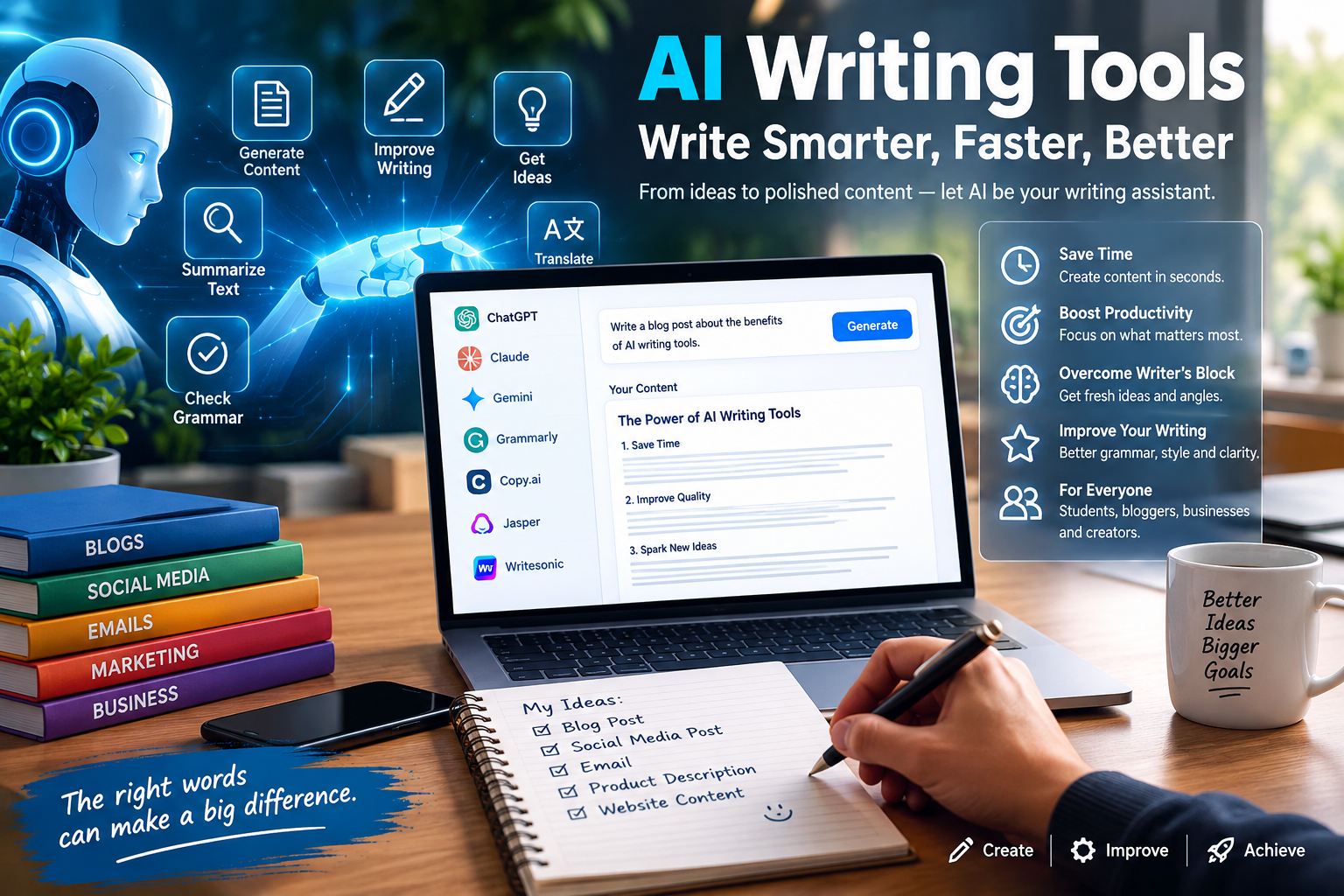
Modern AI writing tools can do much more than simply generate paragraphs. Depending on the platform, they can assist with brainstorming, rewriting, proofreading, summarizing, translation, research organization, and many other writing tasks.
Why Are AI Writing Tools Becoming Popular?
One of the main reasons for its popularity is speed.
Writing an article from a blank page can sometimes be difficult. You might know what you want to say but struggle to find the right opening or organize your ideas.
AI can help overcome that initial hurdle.
Instead of staring at an empty document, you can ask an AI tool to create an outline, suggest headlines, or propose various approaches to the topic. You can then flesh out the ideas yourself.
Another reason is accessibility. You don’t need to be an experienced writer to create well-structured content with the help of AI.
However, this does not mean that every AI-generated article is automatically good. Human editing and judgment remain extremely important.
Common Uses of AI Writing Tools
AI writing tools can be useful in many different situations.
1. Blog Writing
Bloggers can use AI to brainstorm topics, create outlines, generate initial drafts, and improve existing articles.
For example, if you run a technology website, you could ask an AI tool for article ideas related to artificial intelligence, smartphones, laptops, cybersecurity, or emerging technologies.
The AI can provide a starting point, but the final article should be reviewed, fact-checked, and personalized before publishing.
2. Social Media Content
Creating regular social media posts can become time-consuming.
AI writing tools can help generate captions, post ideas, short explanations, questions, and promotional content.
A single topic can also be turned into several different formats.
For example, an article about AI could be turned into:
• A Facebook post
• A LinkedIn update
• An X post
• An Instagram caption
• A script for a short video
This makes it easier for content creators and businesses to repurpose their ideas across different platforms.
3. Drafting emails
Writing professional emails is another area where AI can save time.
You can provide a rough draft and ask an AI tool to make it more professional, friendly, concise, or easier to understand.
This can be especially useful for workplace communication, where the writing needs to be clear and professional.
4. Product descriptions
Online sellers often need descriptions for dozens or even hundreds of products.
AI can help create initial product descriptions based on information such as features, dimensions, materials, and intended use.
The seller still needs to verify the information to ensure the AI hasn’t added specifications or claims that aren’t actually true.
5. Grammar and editing
AI writing tools can also act as digital editors.
They can identify spelling errors, awkward sentences, repetitive words, and unclear phrases.
This can be particularly helpful for people writing in a second language.
Instead of completely rewriting their work, users can ask the AI to preserve the original meaning while making the language clearer and more natural.
AI-assisted writing goes beyond mere text generation.
A common misconception is that writing with AI simply involves pressing a button and publishing whatever appears on the screen.
That approach can lead to problems. Quality content still requires human judgment.
An AI tool can generate information that seems convincing but is actually incorrect, outdated, incomplete, or lacking in important context. Therefore, verifying facts is essential—especially when writing about technology, finance, health, law, or current events.
Often, the best strategy is to use AI as an assistant rather than treating it as a substitute for the writer.
Think of it this way:
Humans set the direction. AI assists in the process. Humans make the final decision.
Advantages of AI writing tools
Using AI for writing offers several potential benefits.
Faster content creation
AI can rapidly generate a first draft, allowing writers to devote more time to editing and refining the final result.
Improved idea generation
When you run out of ideas, AI can offer various approaches, questions, headlines, and content structures.
Easier editing
AI can identify confusing sentences and suggest alternative wording.
Assistance with diverse writing styles
The same message can often be written in a professional, casual, approachable, persuasive, or concise tone.
Support for non-native English writers
AI can help users improve grammar, sentence structure, vocabulary, and overall readability.
Limitations to Consider
Despite their usefulness, AI-based writing tools have limitations.
The first is accuracy.
AI systems can sometimes generate incorrect information or confidently assert something that is untrue. Therefore, users should verify important data before publishing it or relying on it.
The second issue is originality.
If thousands of people ask similar questions of an AI tool, the resulting content may feature similar structures or ideas. Consequently, directly publishing AI-generated text can make a website appear generic.
Another aspect to consider is tone.
AI-generated text can sometimes sound repetitive, overly formal, or unnatural. Human editing can give the content a more personal and engaging feel.
There is also the matter of context. AI may not fully understand your audience, brand personality, personal experiences, or business goals unless you provide sufficient information.
How to get better results with AI-based writing tools
The quality of the output often depends on the quality of the instructions.
Instead of asking:
“Write an article about smartphones.”
you could provide more information:
“Write a 1,200-word, beginner-friendly article about the latest smartphone trends. Explain camera improvements, AI features, battery technology, and performance using simple language. Use clear headings and practical examples. Maintain an informative and natural tone.”
The second instruction provides much more contextual information to the AI.
You can also improve the process by working in stages. Start with an outline.
Then, develop the various sections. Next, ask the AI to review the structure and clarity. Finally, edit the article yourself and verify key information. This approach usually yields more useful results than requesting a complete article and publishing it without review.
AI Writing Tools for Different Types of Users
Different people can use AI-based writing technology in various ways.
Students can use it to generate ideas, understand complex topics, improve grammar, and organize notes.
Bloggers can use it to research topics, create outlines and drafts, write headlines, and handle editing tasks.
Businesses can use AI for emails, reports, marketing content, product descriptions, and customer communication.
Freelancers can leverage it to streamline repetitive writing tasks and create initial drafts for their clients.
Content creators can use it for video scripts, captions, titles, and content ideas.The key is to understand that the tool should support the user’s work rather than eliminate the need to exercise their own judgment.
Popular AI Writing Tools
The market for AI-powered writing tools has grown rapidly, and a wide variety of options are currently available.
Some are designed as general-purpose AI assistants, while others focus specifically on copywriting, editing, marketing, or business communication.
Examples include tools such as ChatGPT, Claude, Google Gemini, and Grammarly, as well as platforms specializing in AI writing.
Each tool has its own strengths, features, pricing models, and limitations. Users should choose the tool that best suits their actual needs, rather than simply selecting the most popular option.
The Future of AI Writing
AI-based writing technology is likely to become even more integrated into everyday software.
Instead of opening a standalone AI application, users will increasingly find AI features directly within word processors, email apps, browsers, content management systems, and business software.
Future writing assistants could also improve their ability to understand an individual’s preferred writing style, audience, brand guidelines, and past work.
This could transform AI, shifting it from a simple text generator into an intelligent writing assistant that collaborates with the user.
Nevertheless, human creativity will remain essential.
Ideas, experiences, opinions, storytelling, and personal perspectives are elements that are difficult to replace with automated text. Often, the most compelling content arises from combining technology with authentic human experience.
Final Thoughts
AI-powered writing tools have transformed the way many people approach writing.
They can help overcome writer’s block, organize ideas, improve grammar, draft content, and save time on repetitive tasks; however, they do not replace critical thinking, creativity, research, or human editing.
Generally, the best results are achieved by combining the strengths of both.
Let AI help you write faster, but let humans decide what is worth saying.
As AI technology continues to evolve, the real advantage may not go to those who use it to do everything for them, but rather to those who learn to employ it effectively while keeping their own ideas, judgment, and creativity at the heart of the process.