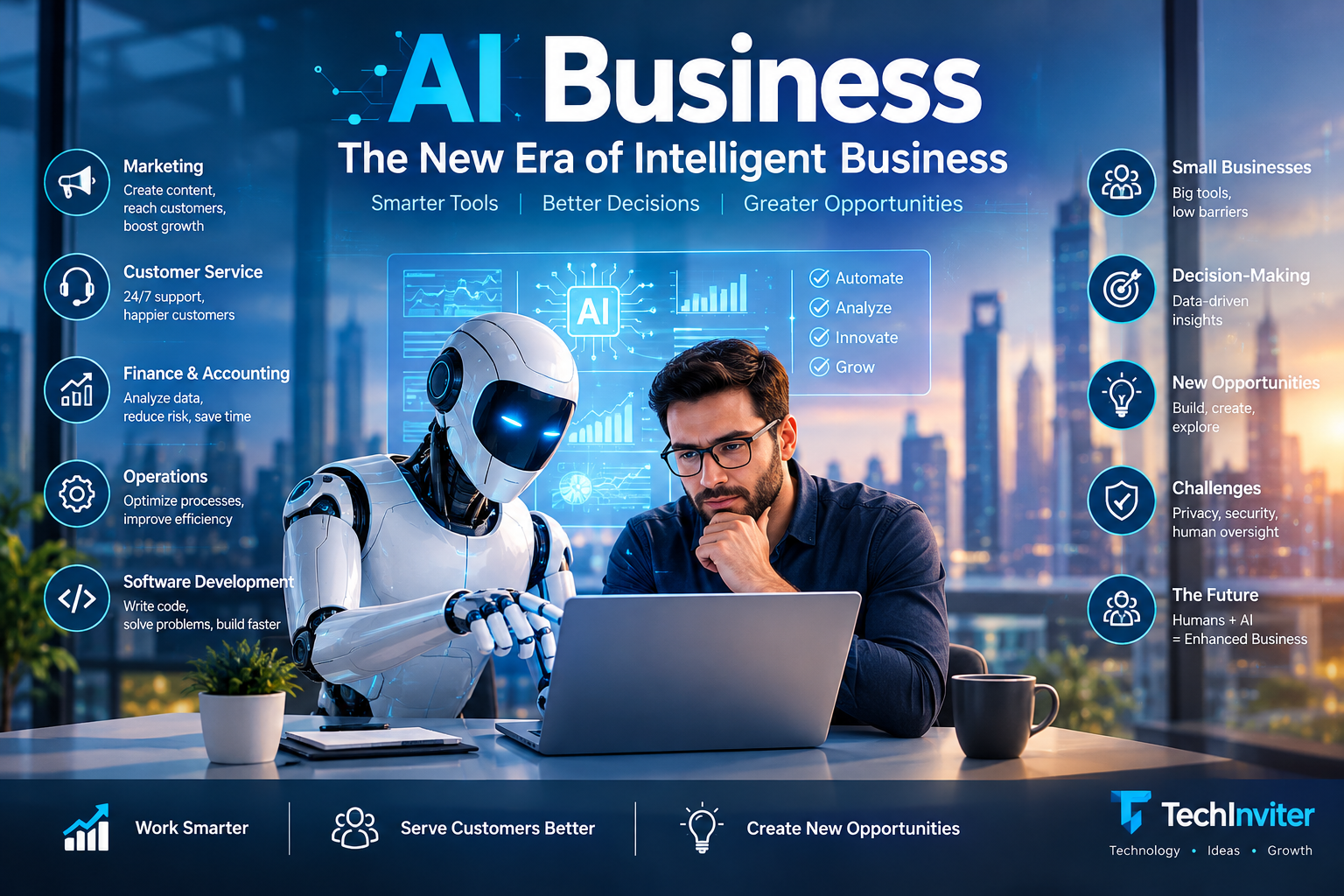
Artificial intelligence is no longer just a technology used by researchers and large technology companies. It is rapidly becoming one of the most important tools for modern businesses. From customer service and marketing to finance, operations, software development, and decision-making, AI is changing how companies work. Businesses that once depended entirely on manual processes can now automate repetitive tasks, analyze large amounts of information, and create new products and services with the help of AI. We are entering a new era of business—an era where AI, automation, data, and human creativity work together.
What Is AI Business?
AI business refers to the use of artificial intelligence technologies to improve business activities, solve problems, automate processes, and create new opportunities. AI can understand information, generate content, recognize patterns, make predictions, communicate with customers, and assist employees with everyday tasks. Modern AI tools can help a small business owner perform tasks that previously required an entire team. For example, a business can use AI to:
• Write Marketing Content
• Create Social Media Posts
• Analyze Customer Data
• Answer Customer Questions
• Generate Product Descriptions
• Summarize Documents
• Create Presentations
• Analyze Financial Information
• Assist Software Developers
• Automate Repetitive Office Tasks
• Research Competitors And Markets
The result is a business environment where technology can handle more routine work while people focus on creativity, strategy, relationships, and important decisions.
Why AI Is Changing Business
Traditional businesses often depend on employees performing repetitive tasks manually. This can consume significant amounts of time and increase the possibility of human error.
AI introduces a different approach. Instead of asking employees to perform every repetitive task themselves, businesses can use AI systems to assist with or automate parts of those processes. For example, a customer service employee may spend hours answering similar questions every day. An AI assistant can handle common questions and provide basic information, allowing employees to focus on more complicated customer issues.
Similarly, a marketing team can use AI to generate initial content ideas, analyze campaigns, and identify customer trends. AI does not necessarily mean replacing people. In many situations, its greatest value comes from helping people work faster and more effectively.
AI in Small Businesses
One of the most interesting aspects of the AI revolution is that its benefits are not limited to large corporations. Small businesses can also use AI tools without building expensive AI systems themselves.
A small online store, for example, can use AI to create product descriptions, respond to customer inquiries, generate advertising ideas, analyze reviews, and prepare social media content.
A freelancer can use AI for research, writing, presentations, coding, image generation, and administrative work. A local business can use AI-powered chatbots to answer customer questions outside normal business hours.
This means AI is reducing some of the technological barriers that previously made advanced business tools accessible mainly to large companies.
AI in Marketing
Marketing is one of the areas where AI is already having a major impact. AI can analyze customer behavior and help businesses understand what customers are interested in. It can also assist marketers in creating content for different platforms. Businesses can use AI for:
- Blog Articles
- Email Campaigns
- Social Media Content
- Advertisement Ideas
- Product Descriptions
- Customer Segmentation
- Market Research
- Search Engine Optimization
- Content Personalization
Instead of starting every campaign from zero, marketers can use AI to generate ideas and first drafts, then apply human creativity and brand knowledge to produce the final content. Marketing is one of the areas where AI is already having a major impact. AI can analyze customer behavior and help businesses understand what customers are interested in. It can also assist marketers in creating content for different platforms. Businesses can use AI for:
• Blog Articles
• Email Campaigns
• Social Media Content
• Advertisement Ideas
• Product Descriptions
• Customer Segmentation
• Market Research
• Search Engine Optimization
• Content Personalization
Instead of starting every campaign from scratch, marketers can use AI to generate ideas and first drafts, then apply human creativity and brand knowledge to produce the final content.
AI in Customer Service
Customer expectations are evolving. People want answers fast, and they want simple help. AI-enabled customer service solutions can help around the clock.
A chatbot powered by artificial intelligence is able to answer simple queries instantly. It can assist customers in locating information regarding products, orders, shipping, refunds, or company policies.
Then the more complicated difficulties could be passed to human staff. That’s a blend of AI automation and human help.” The goal is not only to automate customer support.
The idea is to provide clients with faster access to important information while leaving human personnel to concentrate on situations that require judgment and personal attention.
AI in Finance and Accounting
Financial departments handle large amounts of information every day. AI can assist with tasks such as:
- Data Analysis
- Invoice Processing
- Expense Classification
- Financial Forecasting
- Fraud Detection
- Report Preparation
- Budget Analysis
- Document Processing
AI can identify patterns in financial data much faster than traditional manual processes.
However, financial decisions can have serious consequences, so businesses should maintain appropriate human review, controls, and verification. AI should be treated as an assistant rather than an unquestioned decision-maker.
AI in Business Operations
Business operations consist of several related procedures.
We have to process orders—products to be delivered. Manage inventory. Employees have to cooperate with customers, suppliers, warehouses, and management.
AI enables companies to evaluate their operational data and discover inefficiencies.
For example, an AI system may evaluate delivery statistics and detect repeated delays or patterns in consumer orders.
Companies can also utilize AI for demand forecasting, inventory optimization, automating paperwork, and improving workflow management.
As AI gets more embedded in corporate systems, firms may be able to detect problems before they become big operational issues.
AI in Software Development
AI is changing the game in software development, too.
Today’s AI coding assistants can help developers write code, teach programming ideas, troubleshoot mistakes, provide documentation, and build prototypes.
You tell an AI what you want to construct, and it spits out a first version of the code.
But the code that is generated still needs to be tested, checked for security, and reviewed and understood by humans.
Developers’ roles may progressively shift into building systems, reviewing AI work, addressing complicated challenges, and making architectural decisions.
AI and Business Decision-Making
Businesses generate enormous amounts of data.
Sales transactions, customer interactions, website visits, advertising results, inventory levels, and financial information can all provide useful insights.
AI can analyze these large datasets and identify patterns that may be difficult to detect manually.
For example, a company could use AI to discover:
- Which products are selling faster
- Which customers are most engaged
- Which marketing campaigns generate more interest
- Where operational delays occur
- Which products may experience increased demand?
AI can therefore become an important analytical tool for management.
However, business leaders still need to understand the context behind the data. Business leaders should review an AI-generated recommendation before making it a real-world business decision.
The Rise of AI Employees
An emerging concept is that of “AI agents” or “AI-powered assistants” capable of executing specific business workflows.
Instead of merely answering questions, an AI system could carry out a series of tasks.
For example:
Customer inquiry → Understanding the request → Verifying information → Preparing a response → Updating the system.
Another workflow might involve:
New order → Checking inventory → Preparing documents → Notifying the team → Updating records.
Over time, these systems could execute increasingly complex workflows with minimal human intervention.
This does not mean that companies will replace their workforce with machines; rather, the work environment could evolve toward teams where humans and AI systems collaborate.
AI Creates New Business Opportunities
Every major technological shift creates new business opportunities.
AI is already generating demand for new services, tools, consultants, developers, content creators, automation specialists, and AI-focused companies.
Entrepreneurs can build businesses around:
• AI software
• AI automation
• AI consulting
• AI-powered websites
• AI-driven content services
• AI training
• AI marketing
• AI customer support
• AI data analysis
• AI productivity tools
This opportunity is particularly appealing to small businesses and independent entrepreneurs, as many AI services can be developed using existing platforms and APIs rather than building a full AI model from scratch.
The Challenges of AI Business
The AI revolution also poses significant challenges.
Data Privacy
Companies need to understand how AI systems process information about customers and the company itself. Confidential information should not be entered into AI tools without considering the appropriate privacy and security requirements.
Accuracy
AI can generate incorrect information.
Companies must verify content, calculations, recommendations, and important decisions generated by AI.
Security
AI systems can introduce new security risks. Companies need appropriate access controls, oversight, and security practices.
Human Oversight
Important decisions should not be automatically delegated to AI.
Human oversight remains essential, especially in areas related to finance, employment, legal matters, healthcare, security, and confidential client information.
Employee Skills
As AI becomes more widespread, employees will need new skills.
Knowing how to work with AI, verify its results, provide effective instructions, and integrate AI into workflows could become an important professional competency.
The Future of AI Business
The next stage of AI development could involve deeper integration between AI systems and everyday business software.
Instead of opening a standalone AI application, employees could interact with AI directly within their existing business systems.
Imagine a manager asking:
“Show me this month’s sales performance and explain the most significant changes.”
The AI could analyze business data and generate a summary.
A warehouse manager could ask:
“Which products are low on stock and need reordering?”
The system could analyze inventory data and identify potential stockouts.
A marketing manager could ask:
“Create a campaign based on our best-performing products.”
The AI could prepare a draft campaign based on existing business information.
These examples illustrate how AI could gradually be integrated into standard business workflows.
AI + Humans: The New Business Model
The future of business is unlikely to be simply AI versus humans.
A more realistic model is:
Human intelligence + Artificial intelligence = Empowered enterprise
Humans contribute creativity, experience, judgment, leadership, empathy, and strategic thinking.
AI contributes speed, automation, data processing, pattern recognition, and assistance with repetitive tasks.
When these capabilities are effectively combined, companies can operate more efficiently, allowing employees to focus on higher-value tasks.
Final Thoughts
AI is transforming the business world at an extraordinary speed.
The companies that benefit from AI will not necessarily be those that use the greatest number of AI tools. They will be the ones that understand where AI can generate genuine value and integrate it responsibly into their workflows.
For entrepreneurs, employees, marketing professionals, developers, and business leaders, learning to work with AI is becoming increasingly important. The new era of business is already underway. The key question is no longer whether AI will be part of business.
The bigger question is:
How will your business use AI to work smarter, serve customers better, and create new opportunities?