








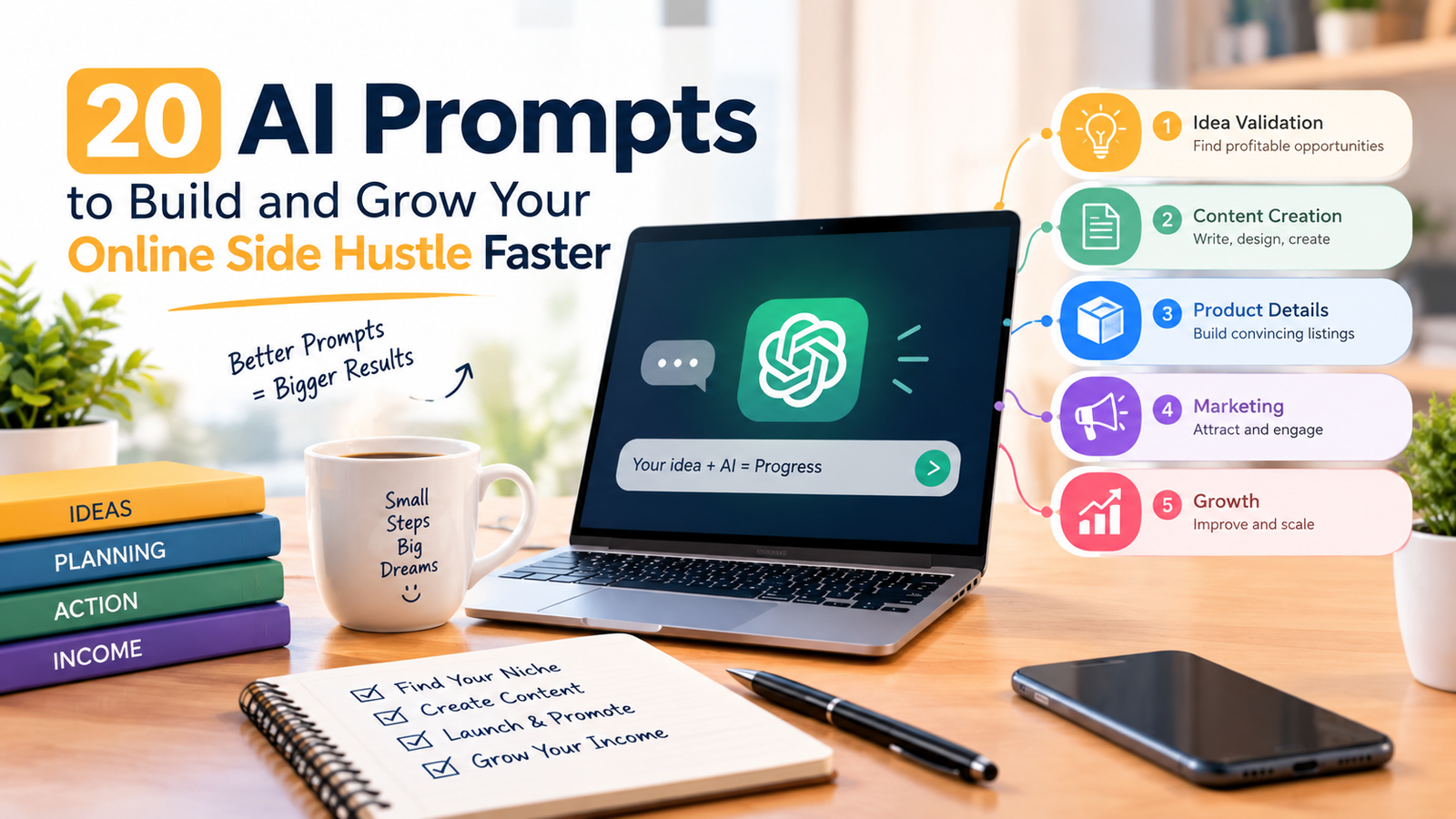
20 AI Prompts to Build and Grow Your Online Side Hustle Faster
Starting an online side hustle used to mean hiring freelancers for research, copywriting, and design, or spending hours doing it all yourself. AI chatbots like ChatGPT and Claude have changed that math — if you know how to ask well.
Below are 20 ready-to-use prompts organized around the real stages of building an online income stream: idea validation, content creation, product details, marketing, and ongoing growth. Copy, paste, and swap in your own details wherever you see brackets.
Idea & Niche Research
1. Validate a niche idea
“I’m considering starting an online business around [your idea]. Act as a market research analyst. Identify the target audience, 3 realistic ways to monetize it, the biggest risks, and 3 similar businesses already succeeding in this space.”
2. Find an underserved sub-niche
“List 10 narrow, underserved sub-niches within [broad topic, e.g., ‘home fitness’] that have passionate audiences but relatively low competition. For each, suggest one content or product angle.”
3. Competitor gap analysis
“Here are 3 competitors in my space: [list them]. Analyze what they’re doing well, what they’re missing, and one clear opportunity I could use to stand out.”
Content Creation
4. Blog post outline
“Create a detailed blog post outline on [topic] targeting the keyword ‘[keyword]’. Include an introduction hook, H2/H3 subheadings, and 3 places where a practical example would strengthen the post.”
5. YouTube script
“Write a YouTube script (8–10 minutes) on [topic] for a channel aimed at [audience]. Include a strong first-15-second hook, clear sections, and a natural call-to-action near the end.”
6. Repurpose one piece of content into five
“Here is a blog post: [paste content]. Turn it into: (1) a 5-tweet thread, (2) a LinkedIn post, (3) a Facebook post, (4) a short-form video script, (5) an email newsletter version. Keep the core message consistent but match the tone to each platform.”
7. Facebook post that drives engagement
“Write 3 Facebook post variations about [topic/product] — one story-driven, one question-based to spark comments, and one with a clear limited-time offer.”
8. Content calendar
“Create a 30-day content calendar for [platform] around [niche], with a mix of educational, entertaining, and promotional posts. Include post type and a one-line topic for each day.”
Amazon KDP & Digital Products
9. Book niche and title research
“I want to publish a non-fiction book on Amazon KDP about [topic]. Suggest 5 profitable sub-niches with long-term demand, and for the best one, give me 5 title and 5 subtitle options.”
10. Chapter outline
“Create a full chapter-by-chapter outline for a book titled ‘[title]’ on [topic], aimed at [audience]. Each chapter should include 3–4 key points to cover.”
11. Amazon book description
“Write an Amazon book description for ‘[title]’ that hooks the reader in the first two sentences, highlights 3 key benefits, and ends with a clear reason to buy now.”
12. Digital product idea generator
“Based on my skills in [your skills/niche], suggest 10 digital product ideas I could sell (templates, courses, printables, tools) ranked by how fast they’d be to create versus their earning potential.”
E-commerce & Product Listings
13. Product description that sells
“Write a persuasive product description for [product] that highlights 3 benefits (not just features), addresses one common objection, and ends with a clear call-to-action.”
14. Product research
“I’m considering selling [product] online. Summarize typical price ranges, the biggest customer complaints based on common reviews for similar products, and 2 ways I could differentiate mine.”
SEO & Website Traffic
15. SEO keyword cluster
“Give me a keyword cluster of 15 related search terms around ‘[main keyword]’, grouped by search intent (informational, commercial, transactional).”
16. Meta title and description
“Write 3 SEO-friendly title tag and meta description options for a page about [topic/product], each under 60 characters for the title and 155 characters for the description.”
Email & Sales
17. Welcome email sequence
“Write a 3-email welcome sequence for new subscribers who downloaded [lead magnet]. Email 1: deliver value and set expectations. Email 2: build trust with a story or case study. Email 3: soft-pitch my main offer.”
18. Sales page outline
“Create a sales page outline for [product/service] using a problem-agitate-solve structure, including a headline, 3 subheads, and an FAQ section addressing likely objections.”
Automation & Productivity
19. Automate a repetitive task
“I currently spend time each week doing [repetitive task]. Suggest 3 ways I could partially or fully automate this using AI tools or simple automation platforms, ranked by ease of setup.”
20. Weekly priority planner “Here are my current projects: [list them] with roughly how much monthly income each one generates. Help me rank them by return on time invested and suggest which 1–2 I should focus most of this week on.”
How to Get Better Results From These Prompts
- Be specific, not generic. Replace every bracket with real details — audience, niche, product name. Vague inputs produce vague outputs.
- Iterate. Treat the first AI response as a draft, not a final answer. Follow up with “make this more [specific/conversational/concise]” to refine it.
- Fact-check anything specific. AI can confidently state outdated pricing, statistics, or platform rules — verify anything numeric or policy-related before publishing or acting on it.
- Build a swipe file. Save the prompts that consistently work well for your niche in a simple document so you’re not rewriting them from scratch each time.
FAQ
Which AI tool should I use for these prompts?
Most work well in ChatGPT, Claude, or Gemini. For long-form content and research-heavy prompts, Claude and ChatGPT tend to perform especially well; for anything needing current, up-to-date information, use a version with web search enabled.
Can these prompts replace hiring a freelancer entirely?
For early-stage and budget-conscious projects, often yes for first drafts. For final, polished, brand-critical content (a sales page, a book’s final edit), many successful side-hustlers still use AI for the first 80% and a human editor for the final pass.
How do I make AI content sound less robotic?
Feed it examples of your own writing or voice, ask it to match that tone specifically, and always do a manual edit pass — AI is a speed tool, not a final-draft tool.
Conclusion
The side-hustlers winning with AI in 2026 aren’t the ones using it the most — they’re the ones using it most specifically. Start with 2–3 prompts from this list that match whatever stage your project is at right now, customize them with real details, and build from there.
SOURCES
- Industry roundups on AI prompt usage for small businesses (2026), cross-referenced for accuracy of current tool landscape.
- General prompt-engineering best practices consistent with OpenAI and Anthropic’s own published prompting guides.