








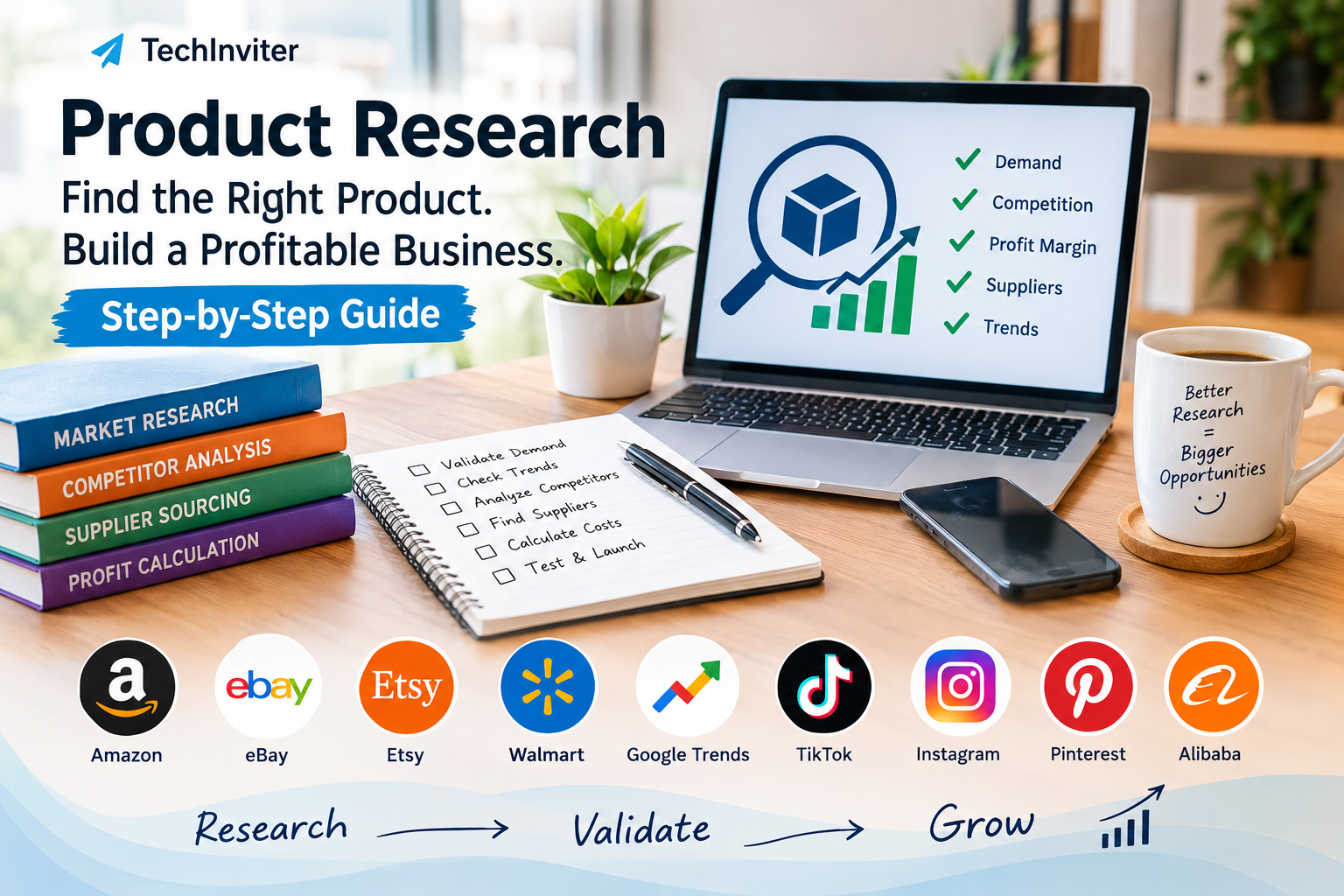
Finding a product to sell online is easy. Finding a product with real demand, manageable competition, reasonable costs and a realistic opportunity to make a profit requires proper research.
This guide explains how to research a product before spending money on inventory, advertising or a private-label order.
You will learn how to:
- Find product ideas
- Check whether people are interested in a product
- Research Amazon, eBay, Etsy and Walmart
- Check Google Trends
- Research TikTok and social media trends
- Analyze competitors
- Read customer reviews
- Find problems with existing products
- Research suppliers
- Calculate the real cost and potential profit
- Check shipping and return risks
- Check product restrictions
- Order samples
- Test a product before buying large quantities
- Make a final product decision
Important: There is no single website or tool that can tell you whether a product will succeed. Use several sources and compare the evidence before investing money.
1. What Is Product Research?
Product research is the process of studying a product before deciding whether to sell it.
A proper product research process answers questions such as:
- Do customers want this product?
- Are people searching for it?
- Are people buying it?
- How much are customers paying?
- How many competitors are selling it?
- What do customers dislike about existing products?
- Can you source it at a reasonable cost?
- How much will shipping and other expenses cost?
- Can you make a reasonable margin?
- Are there legal, safety or certification requirements?
- Can you offer something better or different?
The goal is not to find a product that is guaranteed to succeed. The goal is to reduce unnecessary risk before investing money.
2. The Product Research Process
Follow these steps in order:
Step 1: Find product ideas
↓
Step 2: Check demand
↓
Step 3: Check trends
↓
Step 4: Check marketplaces
↓
Step 5: Analyze competition
↓
Step 6: Read customer reviews
↓
Step 7: Find product opportunities
↓
Step 8: Research suppliers
↓
Step 9: Calculate total costs
↓
Step 10: Check restrictions and risks
↓
Step 11: Order a sample
↓
Step 12: Test the product
↓
Step 13: Decide whether to launch, improve or reject it.
3. Step 1: Find Product Ideas
Do not immediately choose the first product you find.
Start by creating a list of potential products.
Try to collect around 10–30 product ideas.
You can find ideas from:
- Amazon
- eBay
- Etsy
- Walmart
- Google Trends
- TikTok
- YouTube
- Facebook and Instagram
- Supplier marketplaces
- Customer complaints
- Competitor websites
At this stage, you are only collecting ideas.Do not buy inventory yet.
4. Step 2: Check Whether People Want the Product
After creating your list, investigate demand.
Ask:
Are people searching for it?
Use Google Trends and marketplace search results.
Are people buying it?
Look for evidence from marketplaces such as Amazon and eBay.
Is interest growing or declining?
Check historical trends instead of relying only on a recent viral video.
Is the product seasonal?
For example, some products may have strong demand around:
Valentine’s Day
- Ramadan
- Back-to-school season
- Summer
- Winter
- Weddings
- Sports events
A product with seasonal demand is not automatically bad, but you need to understand when customers are likely to buy it.
5. Step 3: Check Google Trends
Use Google Trends to compare product keywords and examine interest over time.
Check:
- Last 12 months
- Last 5 years
- Your target country
- Related searches
- Seasonal patterns
Look for whether interest appears:
Rising
Stable
Declining
or
Highly seasonal
Do not make your decision from one sudden spike. A temporary viral trend can disappear quickly.
6. Step 4: Research Amazon
Amazon is one of the most useful places to research physical products.
Search the product and examine the first several pages of results.
Check:
- Selling prices
- Number of competitors
- Product ratings
- Number of reviews
- Product variations
- Product features
- Images
- Bundles
- Customer complaints
- Shipping
- Sponsored listings
Amazon also provides Product Opportunity Explorer for researching customer demand, search terms, competition and other opportunity information.
Official Amazon resource:
https://sell.amazon.com/tools/product-opportunity-explorer
What should you write down?
For each important competitor, record:
| Information | Example |
| Product | Kitchen organizer |
| Price | $24.99 |
| Rating | 4.4 |
| Reviews | 2,500 |
| Main feature | Expandable |
| Main complaint | Weak material |
| Opportunity | Stronger construction |
Do not copy the competitor. Use the information to understand the market.
7. Step 5: Research eBay
eBay can provide another perspective because you can investigate sold products and historical sales information.
Check:
- Sold prices
- Average selling price
- Number sold
- Sell-through information
- Shipping cost
- Competition
- Product condition
- Seasonal demand
Use eBay Product Research where available.
Official eBay resource:
https://www.ebay.com/help/selling/selling-tools/terapeak?id=4853
The important question is:
Are products similar to this actually selling?
8. Step 6: Research Etsy
Etsy is particularly useful for products such as:
- Handmade products
- Personalized products
- Gifts
- Home décor
- Wedding products
- Jewellery
- Crafts
- Customized products
Look at:
- Popular products
- Search terms
- Prices
- Reviews
- Product personalization
- Customer complaints
- Product presentation
Etsy also provides Marketplace Insights for sellers.
Official resource:
https://help.etsy.com/hc/en-us/articles/35122361353239-How-Do-I-Use-Etsy-s-Marketplace-Insights-Tool
9. Step 7: Research Walmart
Walmart Marketplace can provide another source for product and pricing research.
Check:
- Product availability
- Selling prices
- Competitors
- Reviews
- Product categories
- Customer demand
- Seasonal products
Walmart also provides assortment-growth information for marketplace sellers.Official resource:
https://marketplace.walmart.com/assortment-growth-dashboard/
10. Step 8: Check TikTok and Social Media
Social media can help identify products receiving attention.
Check:
- TikTok
- YouTube
Look for:
- Product demonstrations
- Customer reactions
- Repeated products
- High engagement
- Product problems
- Advertising angles
- Comments asking where to buy
TikTok Creative Center can also help research trends and advertising examples.
Important:
A viral product is not automatically a profitable product.
A product can receive millions of views but still have:
- Low margins
- High competition
- High returns
- Expensive shipping
- Poor quality
- Short-lived demand
11. Step 9: Check Competitors
Once you have evidence of demand, study the competitors.
Look at at least 5–10 serious competitors.
Record:
- Price
- Features
- Materials
- Size
- Colors
- Packaging
- Warranty
- Shipping
- Reviews
- Rating
- Customer complaints
- Product weaknesses
Ask:
Why would a customer buy my version instead of the existing products?
If you cannot answer this question, continue researching.
12. Step 10: Read Customer Reviews
Customer reviews can reveal opportunities that product research tools may not show.
Read:
5-star reviews
What do customers love?
3-star reviews
What could be improved?
1-star and 2-star reviews
What problems repeatedly occur?
Look for repeated complaints such as:
- Product breaks
- Wrong size
- Poor material
- Difficult to use
- Difficult to clean
- Poor packaging
- Missing accessories
- Poor instructions
- Product does not work as expected
Create a simple list:
| Customer problem | How you could improve it |
| Breaks easily | Stronger material |
| Too small | Offer a larger version |
| Difficult to clean | Redesign removable parts |
| Poor packaging | Improve packaging |
| Missing accessory | Add accessory |
This is one of the most useful parts of product research.
13. Step 11: Find Your Product Opportunity
Now ask:
What can I improve?
Possible improvements include:
- Better material
- Better design
- Better packaging
- Better instructions
- Different size
- Additional size options
- Better accessories
- Better bundle
- Easier cleaning
- Easier storage
- Better customer support
- Better warranty
- Different target customer
You do not always need to invent a completely new product.
Sometimes the opportunity is to solve an existing customer problem better.
14. Step 12: Research Suppliers
After finding a promising product, investigate suppliers.
Possible sources include:
- Alibaba
- Manufacturer websites
- Wholesale suppliers
- Local suppliers
- Trade shows
- Verified sourcing companies
When comparing suppliers, check:
- Product price
- Minimum order quantity
- Sample availability
- Production time
- Materials
- Product customization
- Packaging customization
- Shipping options
- Supplier experience
- Quality-control options
- Certifications where applicable
- Communication quality
Do not automatically choose the supplier with the cheapest price.
15. Step 13: Order a Sample
Before placing a large order, get a sample whenever practical.
Test:
- Product quality
- Size
- Weight
- Materials
- Functionality
- Durability
- Packaging
- Accessories
- Instructions
- Appearance
If possible, allow other people to test the product and give you honest feedback.
Ask:
Would you actually buy this product?
A sample can reveal problems that product photos and supplier descriptions cannot.
16. Step 14: Calculate the Real Cost
Never calculate profit using only:
Selling price − supplier price
Your real cost can include:
- Product cost
- Shipping
- Customs/duties where applicable
- Packaging
- Marketplace fees
- Payment processing
- Advertising
- Fulfilment
- Storage
- Returns/refunds
- Software
- Other operating expenses
- Taxes where applicable
Use:
Selling Price − Total Costs = Estimated Profit
Example
Selling price: $29.99
Product: $7.00
Shipping: $3.00
Packaging: $1.00
Marketplace/payment fees: $5.00
Advertising: $4.00
Other costs: $2.00
Estimated remaining amount:
$7.99 This is only an example. Your actual costs will depend on your business model and selling country.
17. Step 15: Check Shipping
A product can appear profitable until shipping is included.
Check:
- Product weight
- Product dimensions
- Package dimensions
- Shipping destination
- Shipping method
- Volumetric weight
- Fragility
- Battery requirements
- Liquid restrictions
- Oversized shipping
- Storage requirements
Small, lightweight and durable products can have different economics from large or fragile products.
18. Step 16: Check Restrictions and Regulations
Before selling a product, determine whether it has special requirements.
Pay particular attention to:
- Food
- Supplements
- Cosmetics
- Children’s products
- Electrical products
- Batteries
- Medical products
- Products making health claims
- Chemicals
- Branded products
- Patented products
- Copyrighted designs
Requirements vary by country and product category. Check the applicable official government, marketplace and regulatory sources before importing or selling the product.
19. Step 17: Check Intellectual Property
Before creating a private-label or modified product, investigate:
- Trademarks
- Patents
- Copyright
- Brand names
- Product designs
- Images
- Packaging designs
Do not assume that changing the color or adding your logo makes a product legally safe to sell. If the product appears to copy another company’s protected design, investigate it before investing.
20. Step 18: Test Before Scaling
Do not immediately purchase a huge quantity.
Where appropriate, start with a controlled test.
Possible approaches include:
- Small inventory
- Small marketplace listing
- Small advertising campaign
- Landing page
- Pre-orders where appropriate
- Local market testing
Measure:
- Clicks
- Conversion
- Customer questions
- Sales
- Returns
- Reviews
- Advertising cost
- Profitability
Use the results to decide whether to:
Improve → Continue testing → Scale
or
Stop → Reject the product
21. The Five-Source Product Validation Method
Before investing significant money, try to confirm your product from several independent sources.
Source 1 — Marketplace
Amazon, eBay, Etsy or Walmart
Source 2 — Search
Google Trends and marketplace search data
Source 3 — Social media
TikTok, Pinterest, Instagram, Facebook or YouTube
Source 4 — Customer feedback
Reviews, comments and discussions
Source 5 — Supplier economics
Supplier price, shipping and other costs The more evidence you have from independent sources, the better you can understand the opportunity.
22. Product Research Worksheet
Use this worksheet for every product you investigate.
| Research Area | Your Findings |
| Product name | |
| Target customer | |
| Main problem solved | |
| Amazon price | |
| eBay price | |
| Etsy price | |
| Walmart price | |
| Google Trends | |
| Social media interest | |
| Number of serious competitors | |
| Average competitor rating | |
| Main customer complaints | |
| Product improvement opportunity | |
| Supplier price | |
| Minimum order quantity | |
| Shipping cost | |
| Marketplace fees | |
| Advertising estimate | |
| Other costs | |
| Estimated total cost | |
| Estimated selling price | |
| Estimated profit | |
| Shipping difficulty | |
| Return risk | |
| Compliance requirements | |
| Intellectual-property concerns | |
| Sample tested | |
| Test results | |
| Final decision |
23. Product Research Final Checklist
Before investing significant money, ask:
☐ Did I confirm that customers want this type of product?
☐ Did I check more than one marketplace?
☐ Did I check Google Trends?
☐ Did I investigate social-media interest?
☐ Did I research competitors?
☐ Did I read negative reviews?
☐ Did I identify customer problems?
☐ Do I have a realistic way to differentiate the product?
☐ Did I compare multiple suppliers?
☐ Did I calculate all major costs?
☐ Did I calculate shipping?
☐ Did I consider marketplace and payment fees?
☐ Did I consider advertising costs?
☐ Did I investigate returns?
☐ Did I check applicable regulations?
☐ Did I check intellectual-property risks?
☐ Did I order a sample?
☐ Did I test the product?
☐ Did I create a small testing plan?
☐ Am I comfortable with the amount of money at risk? If several answers are No, continue researching before investing.
24. Product Research Red Flags
Be careful when:
- Demand exists only because of a short viral trend.
- Competition is extremely strong and products are nearly identical.
- You cannot identify a customer problem you can solve.
- The supplier refuses to provide a sample.
- Product quality is inconsistent.
- Shipping costs are too high.
- The product is fragile.
- Returns could be expensive.
- Regulatory requirements are unclear.
- The product appears to infringe another company’s intellectual property.
- The business model requires a large inventory investment before testing.
- Your profit calculation works only under perfect conditions.
25. Common Product Research Mistakes
Choosing a product because it is viral
Viral attention can disappear quickly.
Looking only at selling price
A high selling price does not automatically mean high profit.
Looking only at supplier price
Your real cost includes shipping, fees, advertising and other expenses.
Ignoring negative reviews
Negative reviews often reveal opportunities for improvement.
Ordering too much inventory
Test before making a large commitment whenever practical.
Copying competitors
Competition should be studied, not simply copied.
Using only one research tool
Different tools provide different information.
Ignoring regulations
Some products have additional requirements.
26. Useful Product Research Platforms
| Platform | Main use |
| Amazon | Marketplace and competitor research |
| eBay | Sold-product and pricing research |
| Etsy | Handmade, personalized and trend research |
| Walmart | Marketplace and assortment research |
| Google Trends | Search-interest and trend research |
| TikTok Creative Center | Trend and advertising research |
| Meta Ad Library | Advertising research |
| Pinterest Trends | Search and visual trend research |
| Alibaba | Supplier and sourcing research |
Always verify current features, availability and requirements directly with the platform before relying on the information.
27. Final Product Research Rule
The purpose of product research is not to find a product that somebody calls a “winning product.”
The purpose is to answer five important questions:
1. Do customers want it?
2. Can I compete?
3. Can I improve or differentiate it?
4. Can I source and sell it profitably after all relevant costs?
5. Can I test it without taking an unnecessary amount of risk?
If you cannot answer these questions, keep researching.
If you can answer them with evidence, you have a much stronger foundation for your next step.Research first. Test small. Measure results. Improve. Then scale.