






1. What Is Dropshipping?
Dropshipping is an ecommerce fulfillment method where you sell products without keeping the products in your own inventory.
Instead:
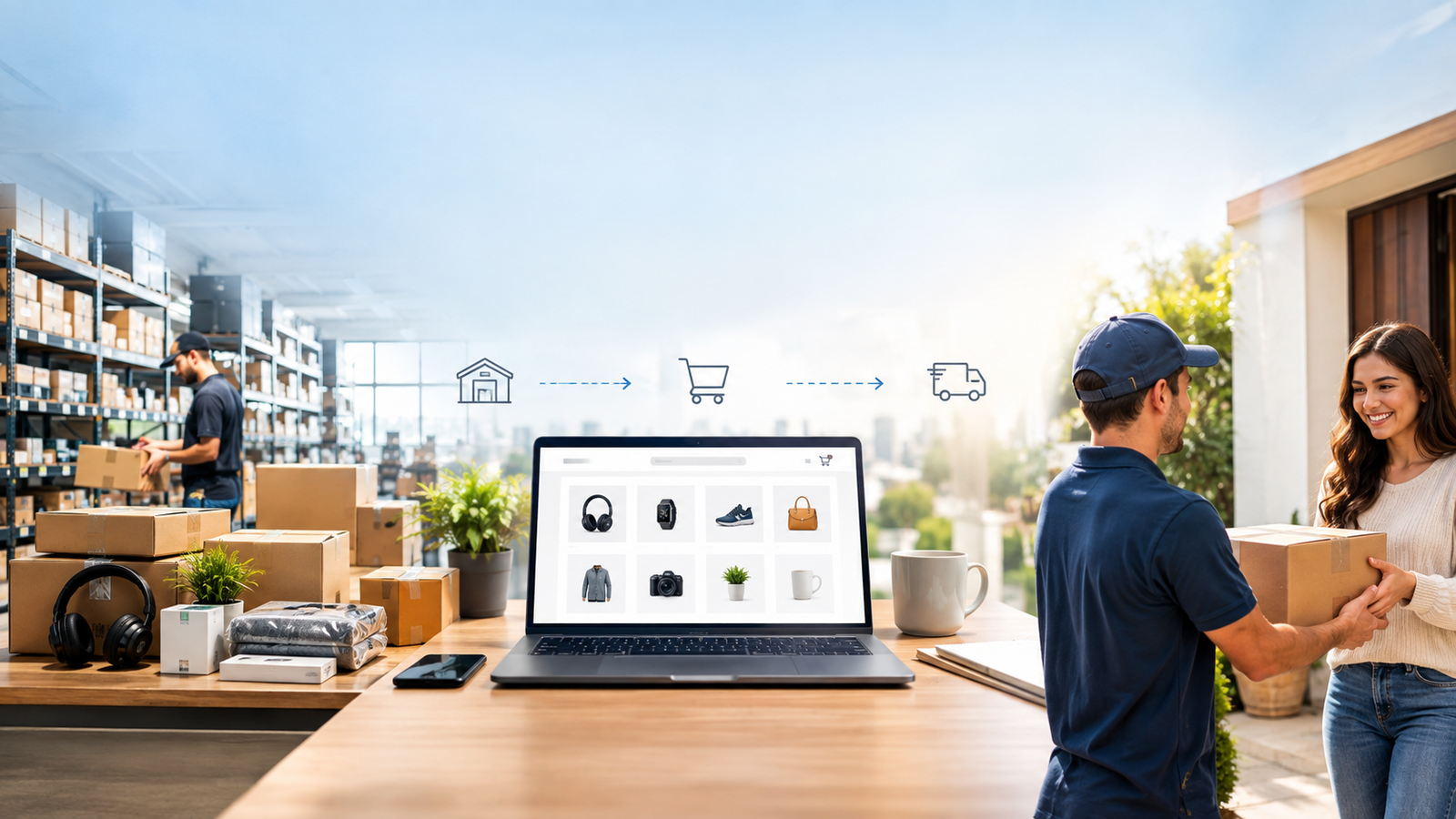
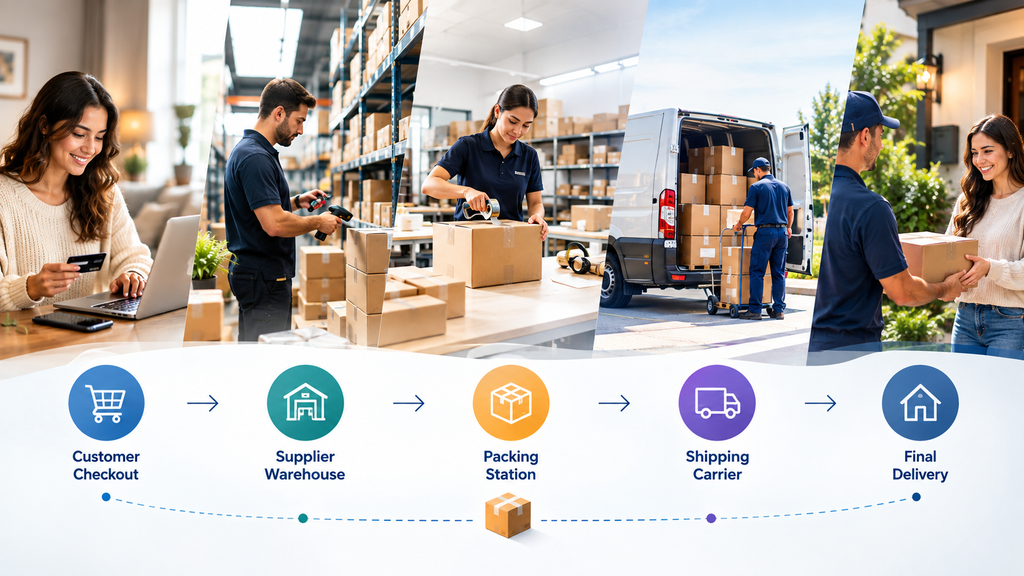
You operate the store → Customer places an order → Supplier fulfills the order → Customer receives the product
The supplier may manufacture, warehouse, package and ship the product directly to your customer. Shopify describes the model in essentially this way, while also noting that the seller remains responsible for the retail relationship with the customer.
Simple example
Suppose:
- Supplier price: $12
- Shipping: $4
- Your store price: $29.99
- Payment/advertising/other costs: $7
Your approximate remaining amount would be:
$29.99 − $12 − $4 − $7 = $6.99
That is an example only. Your actual profit depends on your complete costs.
Who is involved?
A typical dropshipping business involves:
- Customer
- Your ecommerce store
- Payment provider
- Dropshipping supplier
- Shipping/fulfillment company
Basic order flow
Customer → Your Store → Payment → Supplier → Shipping → Customer The important point is that not having inventory does not mean having no responsibility. You still have to manage pricing, marketing, customer service, refunds, policies and applicable legal requirements.
2. Is Dropshipping Still Worth Starting?
Dropshipping remains a possible ecommerce model, but it should not be presented as easy money.
The advantages include lower inventory requirements and the ability to test products without purchasing large quantities upfront. The disadvantages include supplier dependence, competition, shipping problems, product-quality issues and potentially thin margins.
| Advantages | Disadvantages |
| Less inventory to manage | Less control over fulfillment |
| Lower upfront inventory requirement | Supplier mistakes affect your customers |
| Easy to test products | Competition can be high |
| Can operate remotely | Shipping can be complicated |
| Large product selection | Product quality must be monitored |
| Can scale with automation | Customer service remains your responsibility |
Who may consider it?
Dropshipping can suit someone who wants to learn:
- Ecommerce
- Marketing
- Product research
- Sales
- Customer service
- Website management
Who should be careful?
Be cautious if you:
- Expect guaranteed income
- Have no budget for testing
- Do not want to deal with customers
- Cannot handle refunds
- Do not want to research suppliers
Expect a store to succeed simply because it is online
3. Main Dropshipping Business Models
General dropshipping
Sell products sourced from third-party suppliers.
Niche store
Build the store around a specific customer group or category.
Example:
Home organization → Kitchen organization → Specific kitchen products
One-product store
Focus almost entirely on one product.
Useful when the product has a strong problem/solution proposition.
Multi-product store
Sell several related products.
This can provide more opportunities but can also make branding and marketing less focused.
Private-label transition
Start by testing demand through dropshipping and later develop your own branded version.
Print-on-demand
Products are manufactured or printed after an order is received.
Domestic supplier model
Supplier and customer are in the same country or region.
Potential benefits can include simpler delivery and fewer cross-border complications.
International supplier model
Supplier and customer are in different countries.
This can provide product variety but introduces additional shipping, customs and tax considerations.
Marketplace model
Products may be sold through an ecommerce marketplace rather than only through your own website.
Social-commerce model Products are marketed and sold through social platforms or social-shopping features.
4. Choose Your Target Market
Do not start with:
“I want to sell everywhere.”
Start with:
“Who exactly am I selling to?”
Research:
- Country
- City/region where relevant
- Age group
- Customer needs
- Purchasing power
- Shopping behavior
- Preferred payment methods
- Delivery expectations
- Competition
- Local regulations
- Taxes
- Product restrictions
Cross-border selling can create additional tax and customs responsibilities, so requirements should be checked for the specific business and target market.
Local vs international
Local market
Potential benefits:
- Faster shipping
- Easier communication
- Better understanding of customers
- Potentially simpler returns
International market
Potential benefits:
- Larger potential audience
- More product opportunities
Potential challenges:
- Customs
- Taxes
- Currency
- Longer shipping
- Different consumer laws
Payment availability
5. How to Choose a Dropshipping Niche
A niche is the specific market/category you want to serve.
Don’t select a niche only because a product is trending.
Evaluate:
| Factor | Question |
| Demand | Are people actually searching for it? |
| Competition | How many established sellers exist? |
| Price | Can the product support your costs? |
| Margin | Is there room after all expenses? |
| Problem | Does it solve a real problem? |
| Shipping | Is it practical to ship? |
| Returns | Is return risk reasonable? |
| Seasonality | Can demand disappear quickly? |
| Availability | Can suppliers keep it in stock? |
| Marketing | Can you create useful content/ads? |
Strong niche characteristics
A potentially useful niche may:
- Solve a clear problem
- Have identifiable customers
- Have multiple related products
- Allow useful content
- Have reasonable shipping characteristics
- Have repeat or complementary purchases
Warning signs
Be careful with niches dominated by:
- Counterfeit products
- Safety-sensitive products
- Extremely fragile items
- Extremely heavy products
- High-return products
- Products requiring complicated certification
- Products with intellectual-property concerns
6. Product Research
Product research is one of the most important parts of dropshipping.
Look for products that have a reason for customers to buy them.
Product categories to investigate
Problem-solving products
Products that make a task easier.
Trending products
Products experiencing increased attention.
Evergreen products
Products with relatively stable demand rather than depending entirely on a temporary trend.
Impulse products
Products that customers can understand quickly and may purchase without extensive research.
Visual products
Products that can be demonstrated effectively through video or images.
Repeat-purchase products
Products customers may need again.
Evaluate every product
Check:
- Selling price
- Supplier price
- Shipping
- Product quality
- Reviews
- Competitor pricing
- Demand
- Competition
- Product size
- Weight
- Return risk
- Damage risk
- Supplier reliability
Do not choose a product simply because another dropshipper is selling it.
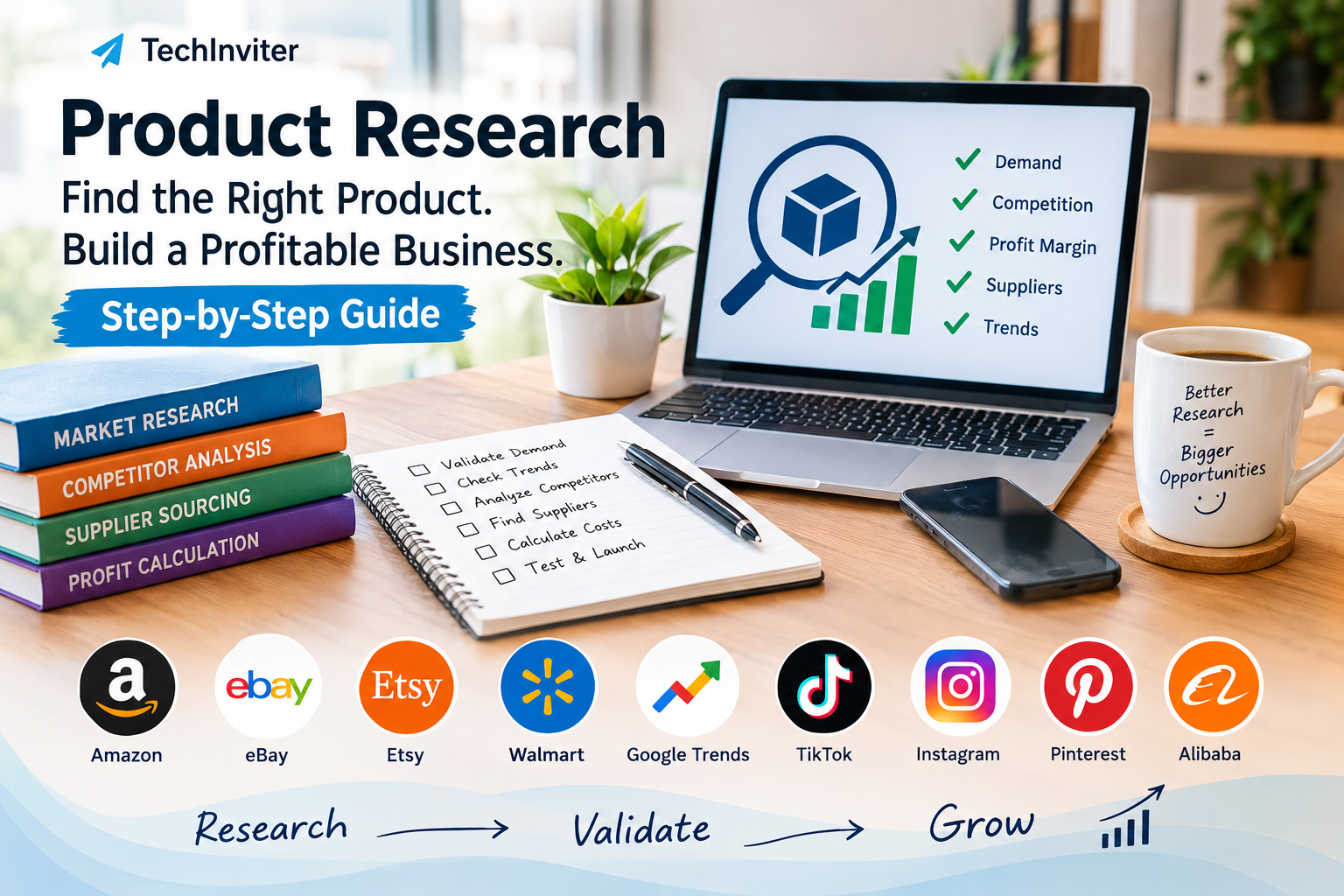
7. Product Validation
Before investing heavily, validate the product.
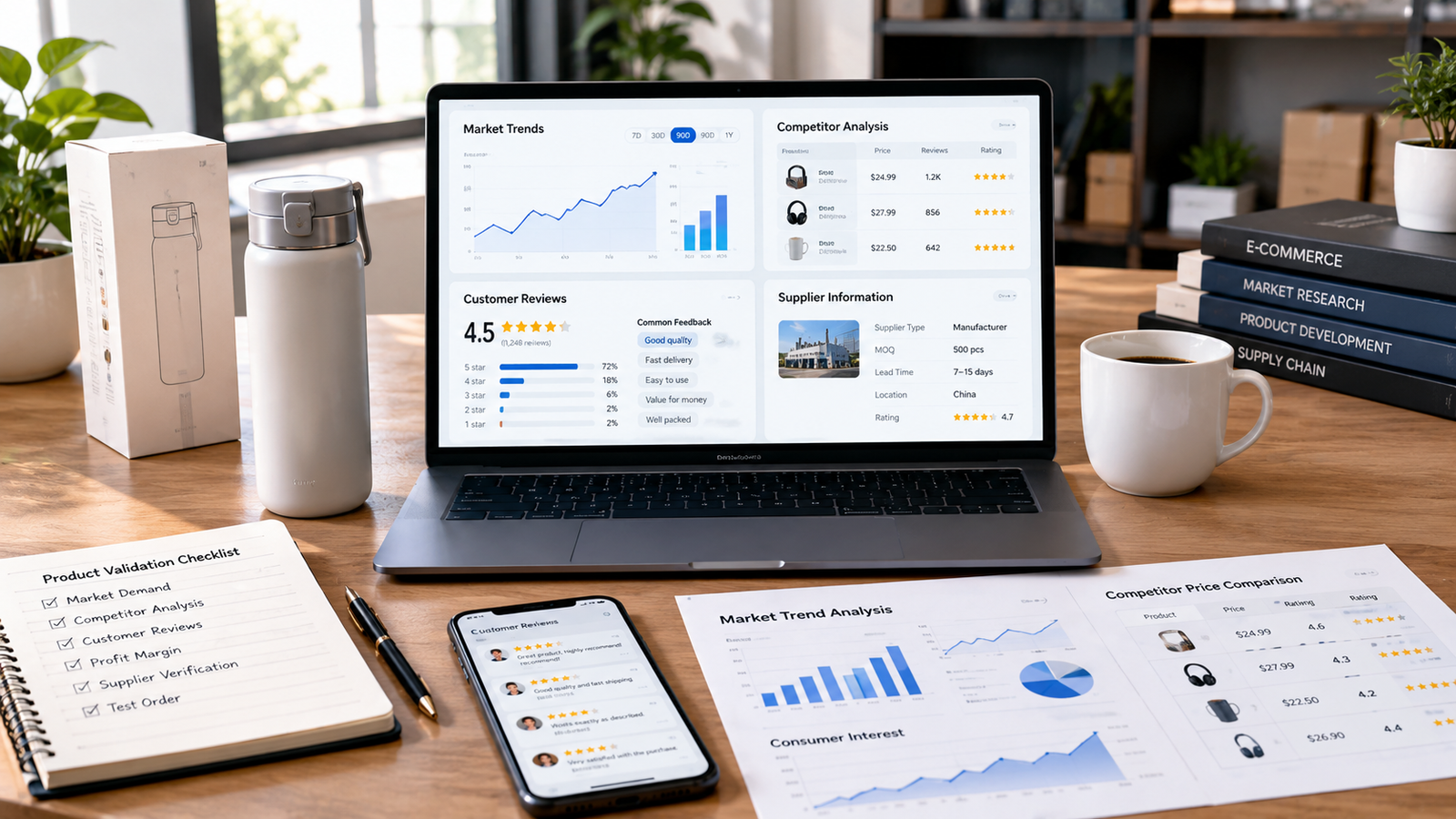
Product validation process
Step 1: Search for demand.
Step 2: Study marketplace listings.
Step 3: Study competitors.
Step 4: Read customer reviews.
Step 5: Examine social-media content.
Step 6: Investigate advertising activity.
Step 7: Compare prices.
Step 8: Check supplier availability.
Step 9: Order a sample.
Step 10: Calculate realistic profitability.
Product validation checklist
- Evidence of customer interest
- Reasonable competition
- Reliable supplier
- Acceptable product quality
- Practical shipping
- Reasonable selling price
- Potential margin
- Low intellectual-property risk
- Manageable return risk
- Suitable for marketing
Sample tested
8. How to Find Dropshipping Suppliers
Potential supplier sources include:
- Supplier marketplaces
- Manufacturers
- Wholesalers
- Local distributors
- Direct supplier relationships
- Print-on-demand companies
- Supplier apps/platforms
When evaluating suppliers, examine:
| Supplier factor | What to check |
| Reviews | Are customers/sellers reporting problems? |
| Processing | How quickly are orders prepared? |
| Shipping | Where are products shipped from? |
| Tracking | Is tracking available? |
| Quality | Can you obtain a sample? |
| Communication | How quickly do they respond? |
| Returns | What happens when something goes wrong? |
| Stock | How frequently does inventory change? |
| Branding | Can packaging be customized? |
| Pricing | Is pricing sustainable? |
Shopify’s current guidance similarly recommends considering supplier location, product range, feedback and product samples when selecting suppliers.
9. Questions to Ask a Supplier
Before working with a supplier, ask:
- What is the product price?
- Is there an MOQ?
- What is the processing time?
- What is the average shipping time?
- Where is the product shipped from?
- Is tracking provided?
- What happens if an item arrives damaged?
- What is your return policy?
- Can you provide samples?
- Can you provide custom packaging?
- Can you remove supplier branding?
- How often is inventory updated?
- What happens when an item is out of stock?
- Are volume discounts available?
Can you provide product specifications and compliance documents where required?
10. Always Consider Product Samples
Never assume a product is good because the supplier’s photos look professional.

Order a sample where practical.
Check:
- Product quality
- Material
- Size
- Packaging
- Shipping time
- Tracking
- Instructions
- Branding
- Damage
- Customer experience
The sample also lets you create your own photos and videos instead of depending completely on supplier material.
11. What You Need Before Launching
A basic dropshipping business may require:
- Business structure where applicable
- Domain
- Ecommerce platform
- Business email
- Supplier
- Payment method
- Shipping arrangement
- Customer-support system
- Store policies
- Analytics
- Marketing plan
The exact business, tax and payment requirements depend on where the business is established and where customers are located.
12. Ecommerce Platform
Two major options include:
Shopify
A hosted ecommerce platform with an ecosystem of apps and supplier integrations. Shopify’s current dropshipping documentation describes supplier apps, Shopify Collective and direct supplier relationships as common approaches.
WooCommerce
A WordPress-based ecommerce solution offering extensive customization.
WooCommerce provides a dropshipping extension that can notify suppliers of orders, group products by supplier and support supplier inventory workflows.
| Factor | Shopify | WooCommerce |
| Setup | Generally straightforward | Requires WordPress setup |
| Customization | High | Very high |
| Hosting | Included | Separate hosting usually required |
| Extensions | Large app ecosystem | Large plugin ecosystem |
| Technical control | More managed | More control |
| Maintenance | More managed | More hands-on |
There is no universally correct platform. Choose based on your technical ability, budget, desired control and business requirements.
13. Build Your Store
Your store should include:
Homepage
Clearly communicate:
- What you sell
- Who you serve
- Why customers should care
Product pages
Include:
- Product title
- Images
- Benefits
- Features
- Specifications
- Price
- Variants
- Shipping information
- Reviews where legitimate
- FAQs
- CTA
Essential pages
- About
- Contact
- FAQ
- Shipping policy
- Return/refund policy
- Privacy policy
- Terms and conditions
Don’t copy supplier descriptions word-for-word. Shopify specifically recommends optimizing imported product information rather than relying on default supplier descriptions and images.
14. Product Page Optimization
A strong product page answers:
What is it?
Who is it for?
What problem does it solve?
Why should I trust this store?
How much does it cost?
When will I receive it?
Features vs benefits
Feature: Adjustable stainless-steel design.
Benefit: Can fit different sizes and makes everyday use more convenient.
Features describe what the product has. Benefits explain why the customer should care.
15. Product Pricing
Use a complete cost calculation.
**Product cost
- Shipping
- Payment fees
- Platform/app costs
- Advertising cost
- Expected refund/return costs
= Total cost**
Then:
Selling price − Total cost = Net profit
Example
Suppose:
- Product = $10
- Shipping = $4
- Payment/transaction costs = $2
- Advertising allocation = $6
- Other costs = $2
Total cost:
$24
Selling price:
$34.99
Approximate remaining amount:
$10.99
This is an illustrative calculation—not a guaranteed margin.
16. Shipping Strategy
Common approaches:
Free shipping
Shipping is incorporated into the product price.
Flat-rate shipping
Customers pay a fixed shipping amount.
Paid shipping
Customer pays the calculated shipping cost.
Domestic fulfillment
Products are shipped from within or close to the target market.
International fulfillment
Products cross borders.
Always communicate realistic delivery estimates.
Do not advertise “2-day delivery” if your supplier normally needs several days to process the order before shipping.
17. Payment Gateways
A payment gateway/payment provider allows customers to pay through supported methods.
Depending on the market, this can include:
- Credit/debit cards
- Digital wallets
- Bank payments
- Local payment methods
- Cash on delivery
Availability varies according to:
- Merchant country
- Business structure
- Payment provider
- Customer country
- Product category
- Compliance requirements
Also consider:
- Transaction fees
- Payout timing
- Chargebacks
- Payment holds
- Currency conversion
18. Marketing Channels
| Channel | Main purpose |
| Paid + organic reach | |
| Visual content | |
| TikTok | Short-form product discovery |
| YouTube | Demonstrations and education |
| Search/product intent | |
| SEO | Long-term organic traffic |
| Influencers | Audience-based promotion |
| Retention and repeat purchases | |
| Content | Education and discovery |
| Retargeting | Re-engage previous visitors |
No single channel works equally well for every product.
19. Organic Marketing Strategy
A beginner can start with:
Step 1
Create useful content around the problem your product solves.
Step 2
Publish demonstrations.
Step 3
Answer customer questions.
Step 4
Create comparison content.
Step 5
Publish tutorials.
Step 6
Repurpose content across relevant platforms.
Step 7
Track which content generates visits and sales.
Organic marketing can take time. Do not judge it only by immediate sales.
20. Paid Advertising
A basic testing structure can involve:
Product → Creative → Audience → Landing/Product Page → Conversion

Test:
- Different images
- Different videos
- Different hooks
- Different audiences
- Different offers
- Different product-page versions
Monitor:
- Clicks
- CPC
- Add-to-cart
- Checkout
- Purchases
- Conversion rate
- CAC
- Profit
Never assume that a high ROAS automatically means high profit. Calculate the complete economics.
21. Content Strategy
Create content such as:
- Product demonstrations
- Before/after demonstrations where truthful
- Problem/solution videos
- Tutorials
- Comparisons
- FAQs
- Customer-generated content where authorized
- Educational posts
- Product-use tips
A good content strategy answers
customer questions before
the customer asks them.
22. First Order Process
Your normal workflow should look like:
Customer visits store
↓
Customer places order
↓
Payment confirmed
↓
Order sent to supplier
↓
Supplier processes order
↓
Product shipped
↓
Tracking supplied
↓
Customer receives product
↓
Follow-up
↓
Review/repeat purchase This supplier-fulfillment workflow is also reflected in Shopify’s current dropshipping documentation.
23. Customer Service
Prepare responses for:
“Where is my order?”
Provide the tracking status and realistic next step.
“My order is delayed.”
Explain the current shipping status without making promises you cannot guarantee.
“I received the wrong product.”
Apologize, verify the order and follow your replacement/refund procedure.
“The product arrived damaged.”
Request appropriate evidence and follow your stated policy.
“I want a refund.”
Check whether the request meets your policy and applicable consumer laws.
“I want to cancel.”
Check the order status before promising cancellation.
24. Returns and Refunds
Your policy should clearly explain:
- Return period
- Eligible products
- Non-returnable products where legally permitted
- Damaged products
- Wrong items
- Missing packages
- Refund process
- Replacement process
- Shipping responsibility
Your supplier’s policy does not automatically replace your obligations to customers. For example, Shopify notes that dropshippers remain responsible for complying with laws applicable to selling products in their markets, including product-safety requirements.
25. Legal, Tax & Compliance
This is one area where you should never copy a generic internet checklist and assume it applies everywhere.
Potential considerations include:
- Business registration
- VAT/GST/sales tax
- Consumer protection
- Privacy
- Terms
- Product safety
- Product certifications
- Intellectual property
- Trademark
- Copyright
- Advertising rules
- Import/export requirements
- Customs
- Data protection
Requirements depend on the business location, customer location and product. For example, Shopify explicitly states that dropshipping merchants must comply with laws applicable to their business and customer locations and that product safety responsibilities can apply to the seller.
26. Products to Avoid or Investigate Carefully
Be especially careful with:
- Counterfeit products
- Trademark-infringing products
- Copyright-infringing products
- Dangerous products
- Highly regulated products
- Products with unclear certifications
- Extremely fragile products
- Very heavy products
- Products with unusually high return rates
- Products making medical or other regulated claims
If you cannot establish that you have the right to sell a product, don’t build your business around it.
27. 20 Common Beginner Mistakes
| Mistake | Better approach |
| Choosing products randomly | Research demand |
| Copying competitors | Study and differentiate |
| Never ordering samples | Test products |
| Using supplier descriptions | Rewrite them |
| Ignoring shipping | Calculate it before launch |
| Underpricing | Calculate all costs |
| Overpricing | Research competitors |
| Selling everything | Start focused |
| Ignoring customer service | Build a support process |
| Trusting supplier blindly | Verify |
| Using fake reviews | Use legitimate reviews |
| Making unrealistic claims | Use truthful claims |
| Ignoring returns | Build a clear policy |
| Ignoring taxes | Check applicable rules |
| Buying too many apps | Use only needed tools |
| Launching without analytics | Install tracking |
| Changing products every day | Test systematically |
| Spending too much on ads immediately | Control testing budget |
| Ignoring profit | Track unit economics |
| Expecting instant success | Treat it as a business |
28. Competitor Research
Study competitors without simply copying them.
Record:
- Product
- Price
- Product positioning
- Offer
- Website
- Product page
- Images
- Video
- Reviews
- Shipping
- Social media
- Advertising
- Content
- Customer experience
Ask:
“What can I make clearer, more useful or more trustworthy?”
29. Important Dropshipping Metrics
| Metric | Meaning |
| Conversion rate | Percentage of visitors who purchase |
| AOV | Average order value |
| CAC | Cost to acquire a customer |
| Gross margin | Revenue remaining after direct product costs |
| Net profit | Money remaining after all applicable costs |
| Refund rate | Percentage of orders refunded |
| Return rate | Percentage of orders returned |
| Cart abandonment | Customers who add products but don’t complete purchase |
| Customer lifetime value | Expected value of a customer over their relationship |
| ROAS | Revenue attributed to advertising divided by ad spend |
Do not evaluate your store using one metric alone.
30. How to Know Whether a Product Is Working
Monitor:
Traffic → Product views → Add to cart → Checkout → Purchase → Profit
Also monitor:
- Refunds
- Returns
- Customer complaints
- Product reviews
- Shipping problems
- Supplier issues
A product can generate sales and still be a poor business product if refunds, support costs or advertising costs consume the margin.
31. When to Stop Testing a Product
Don’t make decisions based purely on emotion.
Ask:
- Did the product receive enough relevant traffic?
- Are people clicking?
- Are people adding to cart?
- Are they beginning checkout?
- Are they purchasing?
- Is the price competitive?
- Is the product page clear?
- Is shipping hurting conversion?
- Is the supplier reliable?
- Is the product profitable after all costs?
Sometimes the problem is the product.
Sometimes it is the offer.
Sometimes it is the creative.
Sometimes it is the store.
Diagnose before abandoning.
32. How to Scale
Once the economics are working, consider:
- More traffic
- Better creatives
- Better conversion rate
- More variants
- Bundles
- Upsells
- Cross-sells
- Higher AOV
- Better supplier pricing
- Faster fulfillment
- Additional marketing channels
- Email retention
- Complementary products
- Private labeling
Scaling should increase business capacity without allowing customer experience to collapse.
33. Automation
Possible automation areas include:
- Order processing
- Inventory synchronization
- Tracking updates
- Customer emails
- Reporting
- Marketing workflows
- Customer support
- Product research
But don’t automate everything.
Human review is still important for:
- Refund disputes
- Complaints
- Product quality problems
- Supplier failures
- Unusual orders
- Legal/compliance issues
- Customer relationships
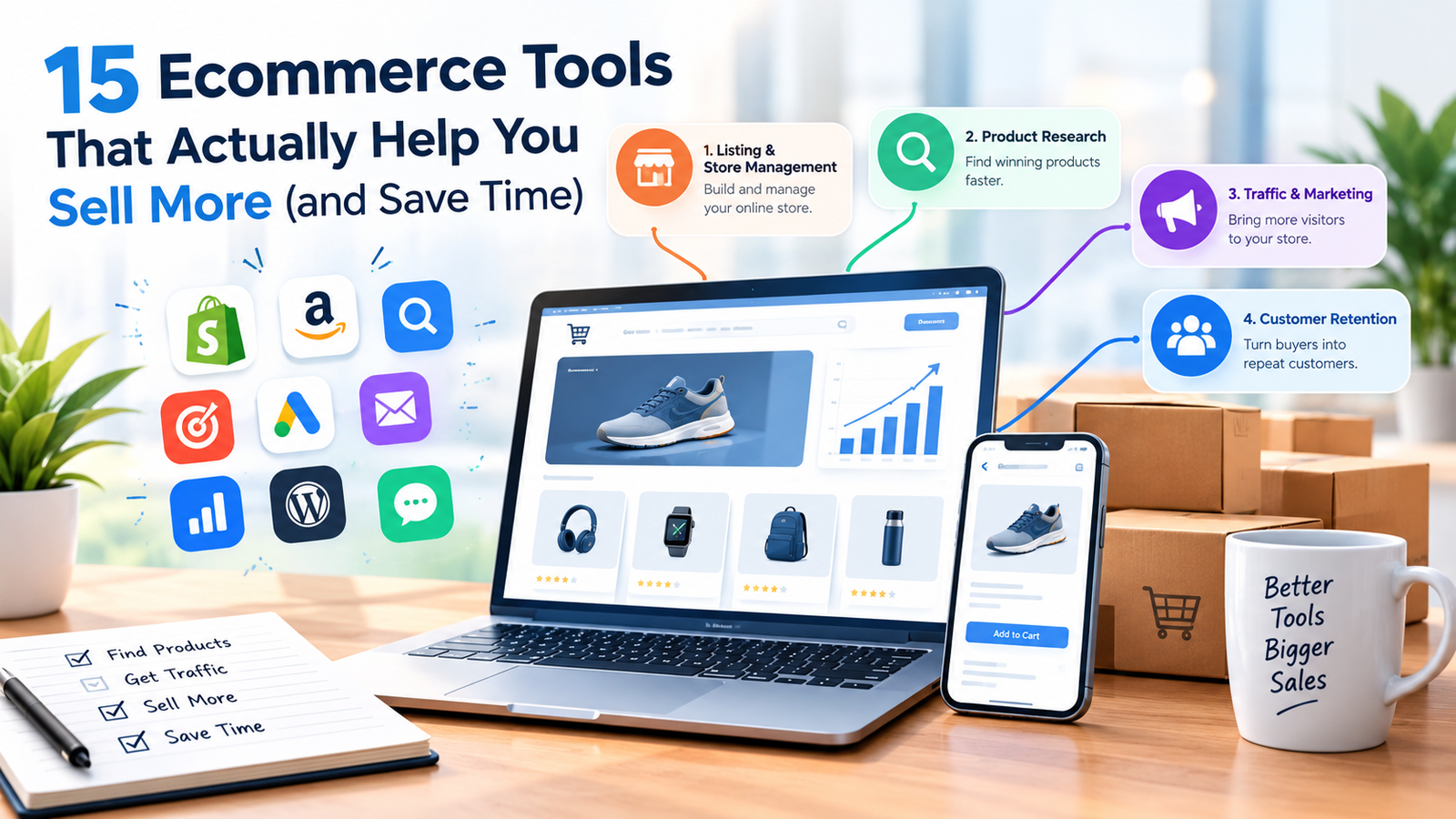
34. Useful Dropshipping Tool Categories
Product research
Find demand and product opportunities.
Keyword research
Understand what customers search for.
Competitor research
Study products, offers and marketing.
Store building
Create and manage the ecommerce store.
Supplier sourcing
Find and communicate with suppliers.
Email marketing
Build customer retention.
Analytics
Understand traffic and sales.
Customer support
Manage customer questions.
Design
Create product images and marketing assets.
Automation
Connect systems and reduce repetitive tasks. Choose tools based on an actual business requirement rather than installing dozens of apps.
35. Example Dropshipping Budgets
These are illustrative planning examples, not required amounts.
Very low-budget test
Possible expenses:
- Domain
- Store/platform
- Sample
- Basic design
- Small marketing test
Moderate test
Add:
- Multiple samples
- Better creative production
- Larger marketing testing
- Email system
- Additional tools
Larger testing budget
May include:
- Multiple products
- Multiple samples
- Professional content
- Larger advertising tests
- More advanced analytics
- Supplier negotiations
Your actual requirements vary by country, platform and strategy.
36. 30-Day Launch Plan
| Days | Task |
| 1–2 | Learn the model |
| 3–4 | Research markets |
| 5–6 | Research niches |
| 7 | Shortlist products |
| 8–10 | Validate products |
| 11–12 | Research suppliers |
| 13 | Contact suppliers |
| 14 | Order samples |
| 15–16 | Choose business/store structure |
| 17 | Domain + branding |
| 18–19 | Build store |
| 20 | Product pages |
| 21 | Policies |
| 22 | Payment/shipping setup |
| 23 | Analytics |
| 24 | Content creation |
| 25 | Marketing preparation |
| 26 | Final store testing |
| 27 | Soft launch |
| 28 | Monitor data |
| 29 | Fix problems |
| 30 | Begin structured testing |
37. Pre-Launch Checklist
- Product selected
- Product validated
- Supplier verified
- Sample reviewed
- Domain connected
- Store functional
- Product page complete
- Pricing calculated
- Shipping explained
- Payment method working
- Policies published
- Contact information available
- Analytics installed
- Checkout tested
- Mobile version tested
- Order process tested
- Supplier process tested
- Marketing content ready
38. Growth Checklist
After receiving sales:
- Track profitability
- Review customer feedback
- Review refund rate
- Review shipping performance
- Improve product page
- Test new creatives
- Improve AOV
- Negotiate supplier pricing
- Improve fulfillment
- Build email retention
- Add complementary products
- Document processes
Automate repetitive tasks
39. Frequently Asked Questions
1. What is dropshipping?
It is an ecommerce fulfillment model where a supplier ships products directly to customers instead of the retailer holding inventory.
2. Do I need a warehouse?
Usually, no. That’s one of the characteristics of the model.
3. Do I need inventory?
Traditional dropshipping does not require you to hold inventory before receiving customer orders.
4. Is dropshipping free?
No. Even without inventory, you may have store, domain, samples, payment, marketing, software and other costs.
5. Can dropshipping be profitable?
It can be, but profitability depends on product economics, marketing, operating costs, supplier performance and customer demand.
6. Is dropshipping easy?
The technical process can be straightforward, but building a profitable business is not guaranteed or automatic.
7. Do I need a website?
Not necessarily for every business model, but an owned ecommerce store can provide greater control over branding and customer experience.
8. Can I use Shopify?
Yes. Shopify currently supports several dropshipping approaches, including supplier apps and Shopify Collective.
9. Can I use WooCommerce?
Yes. WooCommerce supports dropshipping workflows through its ecosystem and official dropshipping extension.
10. Should I order samples?
Yes, whenever practical. Samples allow you to inspect the actual product and customer experience.
11. How many products should I sell?
There is no universal number. A focused product selection can make research, branding and marketing easier.
12. Should I start with one product?
It can be a practical testing approach, particularly when you want to focus your marketing and product page.
13. Can I sell internationally?
Potentially, but you must investigate shipping, taxes, customs, payment availability and consumer requirements for each market.
14. Who handles shipping?
Usually the supplier or fulfillment partner.
15. Who handles customer service?
The store selling the product normally manages the customer relationship.
16. What if the customer wants a refund?
Follow your published refund policy and applicable consumer laws.
17. What if the supplier sends a damaged product?
Have a documented supplier dispute/replacement process.
18. Can I automate dropshipping?
Many operational tasks can be automated, but important exceptions and customer issues still require human oversight.
19. Can I sell branded products?
Only when you have the appropriate rights or authorization.
20. Can I use supplier images?
Check the supplier’s terms and your rights before using them.
21. What products should beginners avoid?
Products with counterfeit risks, unclear safety requirements, extreme fragility, heavy shipping costs or high return risk deserve particular caution.
22. Do I need business registration?
That depends on your jurisdiction and business structure.
23. Do I need to collect tax?
Potential tax obligations depend on your business location, customers, sales volume, products and applicable laws.
24. How much should I spend on advertising?
There is no universal amount. Set a controlled testing budget you can afford to lose and evaluate the resulting economics.
25. How long does it take to succeed? There is no guaranteed timeline. Product validation, store development, marketing and customer acquisition can take different amounts of time.
40. Final Dropshipping Roadmap
Use this as the simple version of the entire guide:
RESEARCH
↓
TARGET MARKET
↓
NICHE
↓
PRODUCT
↓
VALIDATE
↓
SUPPLIER
↓
SAMPLE
↓
BUSINESS SETUP
↓
STORE
↓
PRODUCT PAGE
↓
PRICING
↓
PAYMENT
↓
SHIPPING
↓
MARKETING
↓
FIRST ORDER
↓
CUSTOMER SERVICE
↓
MEASURE
↓
OPTIMIZE
↓
SCALE